Elrha Website Redesign
A case study detailing the end-to-end redesign of Elrha's website – from discovery and user research through UX design, technical migration to Webflow, and accessibility improvements – to create a more intuitive, scalable digital platform.
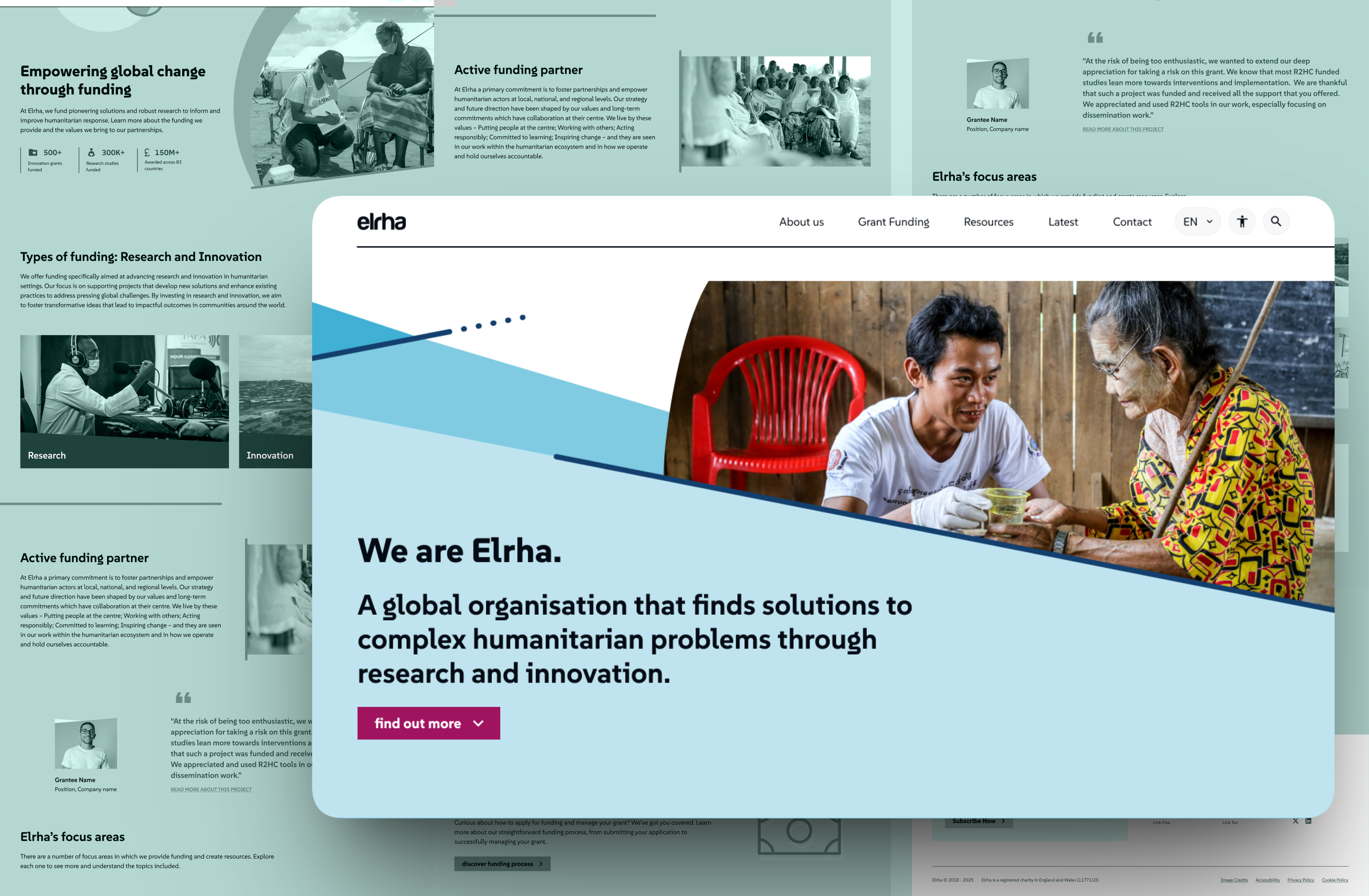

Elrha's website had evolved over many years into a large, content-heavy WordPress platform – spanning over 500 pages of research outputs, funding guidance, programme updates, and sector resources. Although rich in information and underpinned by a strong, widely respected brand, the site no longer served the needs of the organisation or its diverse global audiences.
Visitors – including humanitarian practitioners, academic researchers, NGO grantees, institutional donors, and sector partners – consistently struggled to locate core content. Navigation was unclear, the internal linking structure was inconsistent, and it was difficult to understand how different areas of the site related to one another. On the technical side, the platform suffered from slow page load times, poor search engine visibility, accessibility gaps, and growing maintenance challenges for the internal team.
Despite strong brand equity and positive user sentiment around Elrha's visual identity and reputation, the website failed to reflect the same level of coherence and professionalism. A complete redesign was needed – one grounded in evidence, aligned with modern web standards, and capable of serving a highly varied international audience, including users operating in low-bandwidth environments across the Global South.
How it started
Discovery & UX Research: Understanding Real User Needs
We entered the project by leading a comprehensive Discovery phase designed to surface the realities of how people actually used – and struggled with – Elrha's existing site. This work combined qualitative and quantitative methods across multiple audience types.
Stakeholder Workshops and Persona Development
We facilitated a series of structured stakeholder workshops and in-depth interviews with Elrha's internal teams to define key user personas and map the full range of audience motivations. We identified why different visitor types come to the site, which content areas matter most to them, and where they encounter friction or confusion in the current navigation.
User Research and Behavioural Interviews
Alongside internal stakeholder engagement, we conducted in-depth interviews across six distinct persona groups – including field-based humanitarian practitioners, academic researchers, NGO programme officers, and institutional funders. A supplementary user survey helped quantify behaviours and validate pain points at scale. Findings consistently pointed to the need for a clearer content hierarchy, more intuitive navigation, and faster pathways to specific resources.
Technical, SEO, and Accessibility Audit
In parallel, we conducted a detailed technical audit of the existing WordPress site, covering:
- SEO performance: domain authority, keyword coverage, crawlability, and indexation gaps
- Accessibility compliance: WCAG 2.0 audit identifying failures across colour contrast, keyboard navigation, and screen reader compatibility
- Content quality and duplication: identifying overlapping pages, unclear categorisation, and structural gaps
- Site architecture: mapping legacy URL structures, redirect chains, and internal linking inconsistencies
All findings were synthesised into a comprehensive discovery report, a company-wide presentation, and a working session with Elrha's Senior Leadership Team – ensuring full organisational alignment before any design work began.
What We Delivered
3.1 – Co-Design, Information Architecture & User Testing
We approached the redesign as a collaborative process, working closely with Elrha's team at every stage to validate ideas before committing to solutions. The co-design process began with building out detailed user journey maps – illustrating how each persona type moves through the site, what content they need at each stage, and where the current experience fails them.
These journey maps directly informed a revised information architecture, determining how content should be grouped, what belonged in top-level navigation, and how users could be guided naturally toward relevant resources without guesswork. The new structure prioritises intuitive exploration over rigid hierarchy.
Initial wireframes and an interactive prototype were tested through a second round of user interviews. This testing phase confirmed whether the new structure made sense to real users, revealed how people expected content to be labelled and organised, and validated the overall UX direction. Findings from testing led to refinements in navigation labels, simplified content groupings, and a cleaner visual layout.
3.2 – Advanced Filtering & Content Discovery
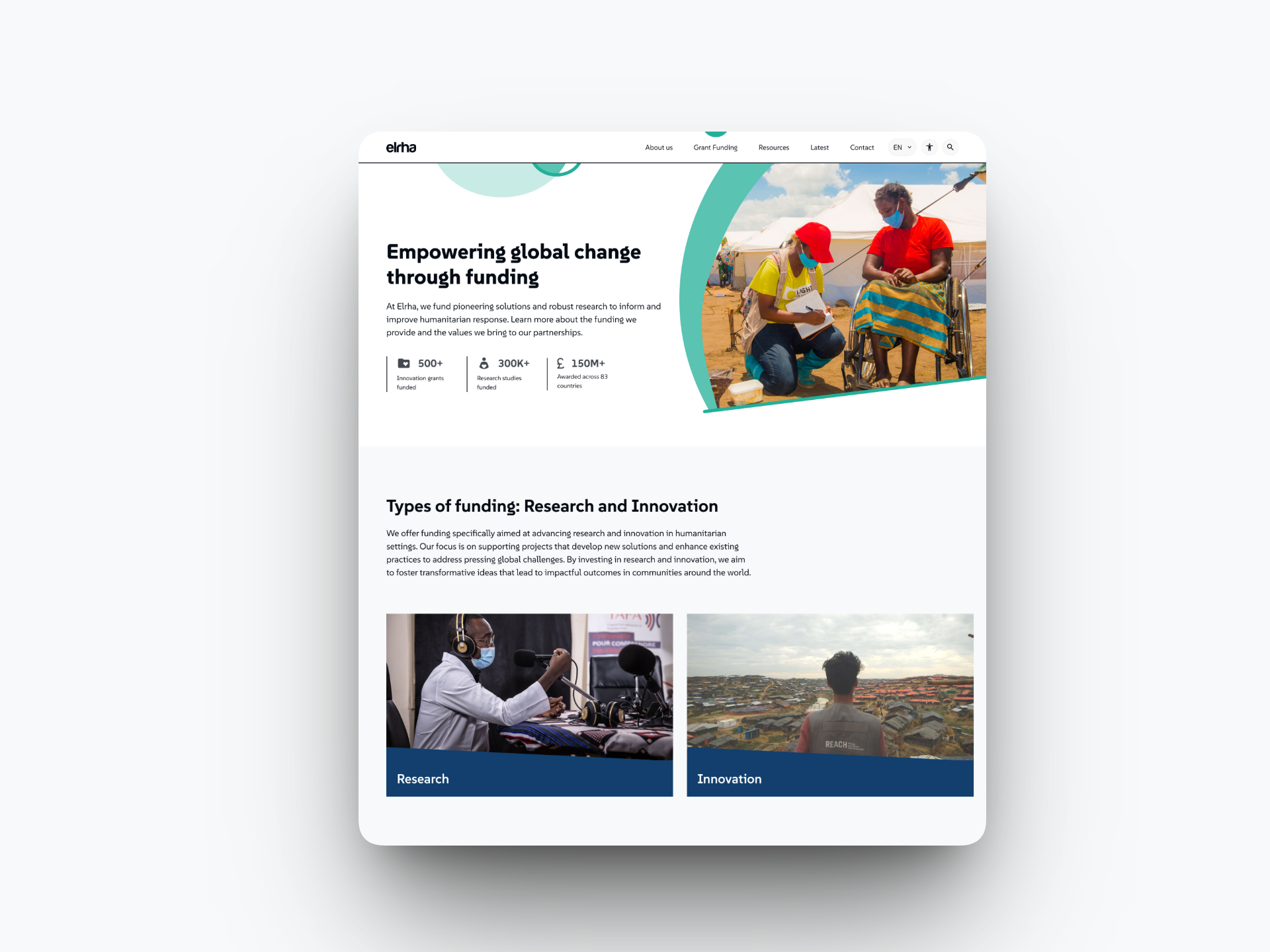
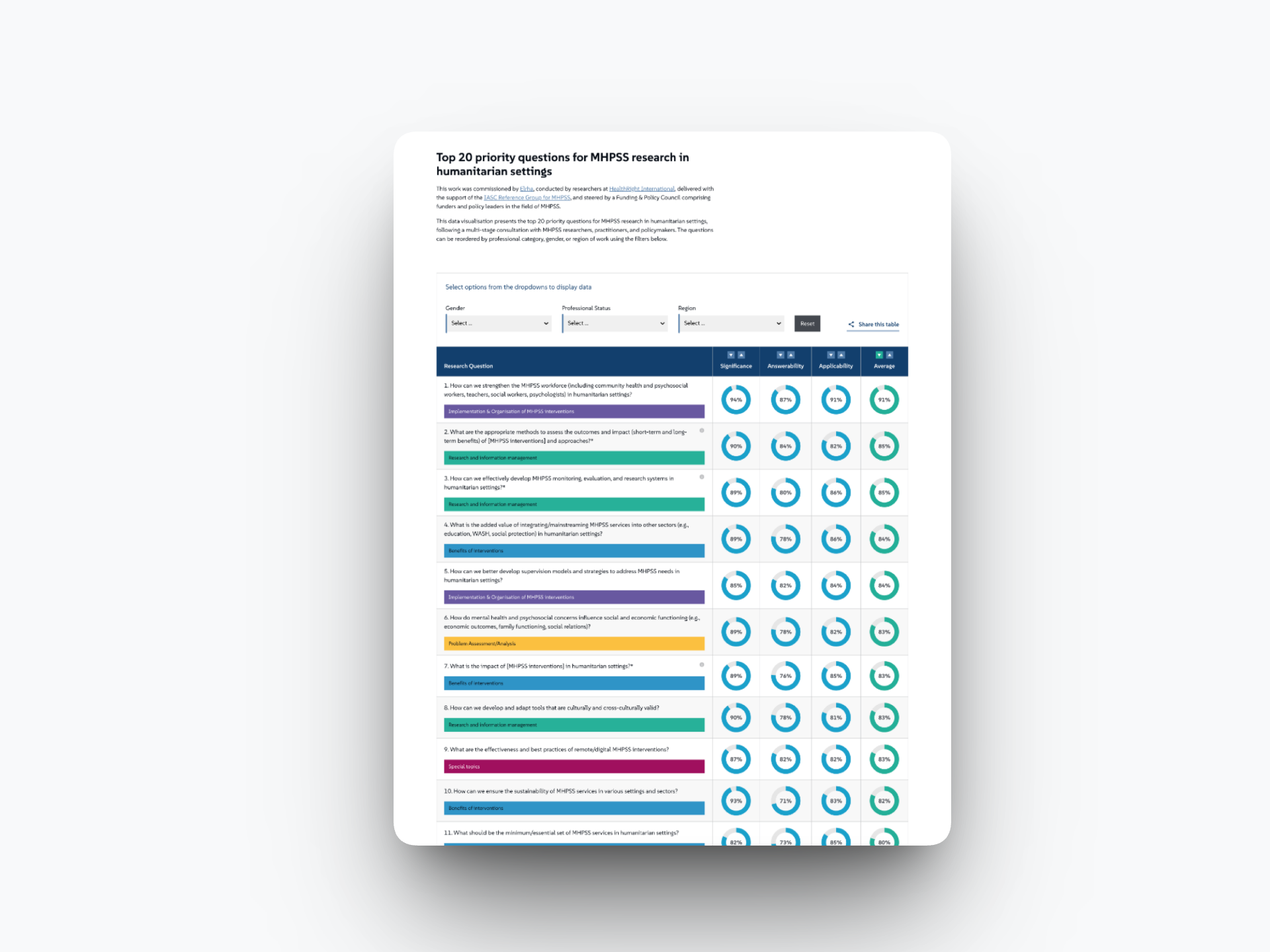
A key deliverable – and a direct response to user research findings – was the development of advanced filtering functionality across Elrha's core resource hubs, including the MHPSS (Mental Health and Psychosocial Support) research library.
Users can now filter content across multiple parameters simultaneously, including topic area, geographic region, publication type, research question, and thematic focus area (such as Gender-Based Violence, WASH, or Nutrition). This significantly reduces the time researchers and practitioners spend locating relevant materials, and makes Elrha's extensive knowledge base meaningfully navigable for the first time.
The filtering system is built within Webflow's CMS architecture, meaning it is fully maintainable by Elrha's internal team without technical support. It also improves SEO performance by enabling clean, indexable URLs for filtered content views.
3.3 – Technical Audit, CMS Evaluation & Content Migration
Alongside the UX and design work, we conducted an in-depth technical review of the legacy WordPress installation. Our SEO analysis identified a heavy reliance on branded search terms and a lack of visibility for non-branded, topic-level queries – particularly for searches related to humanitarian innovation, research funding, and evidence-based programme design.
We evaluated the long-term suitability of WordPress versus Webflow as a CMS platform, producing a structured comparison covering performance, scalability, editorial flexibility, accessibility tooling, and total cost of ownership. Based on this analysis, Elrha chose to migrate to Webflow – a decision that aligned with their goals for content autonomy, reduced technical dependency, and ease of maintenance.
We developed a full content migration strategy, cataloguing and re-mapping legacy content into a structure aligned with the new information architecture. All redirects were planned and implemented to preserve SEO equity and prevent broken links.
3.4 – Brand Expression and Visual Language
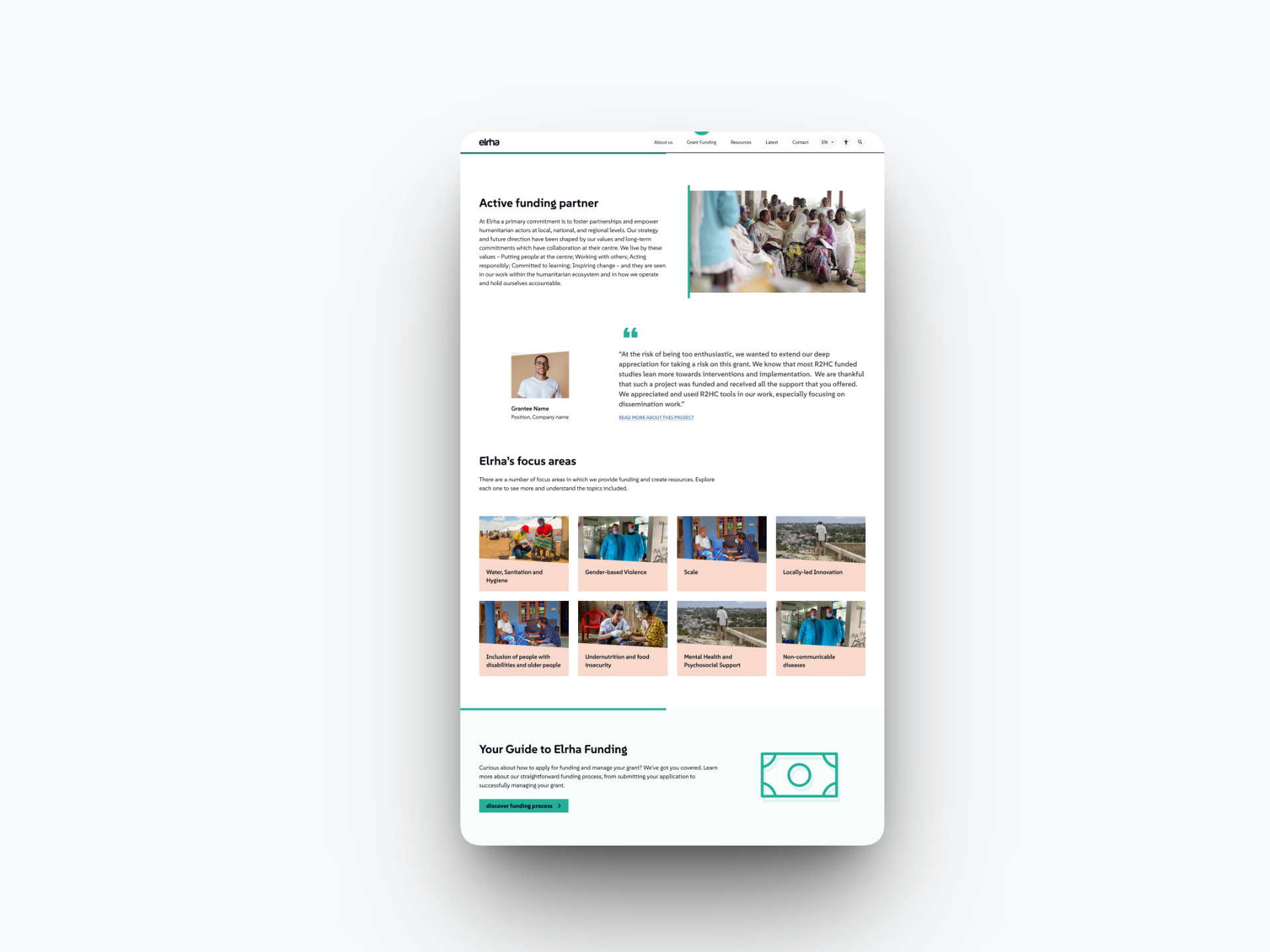
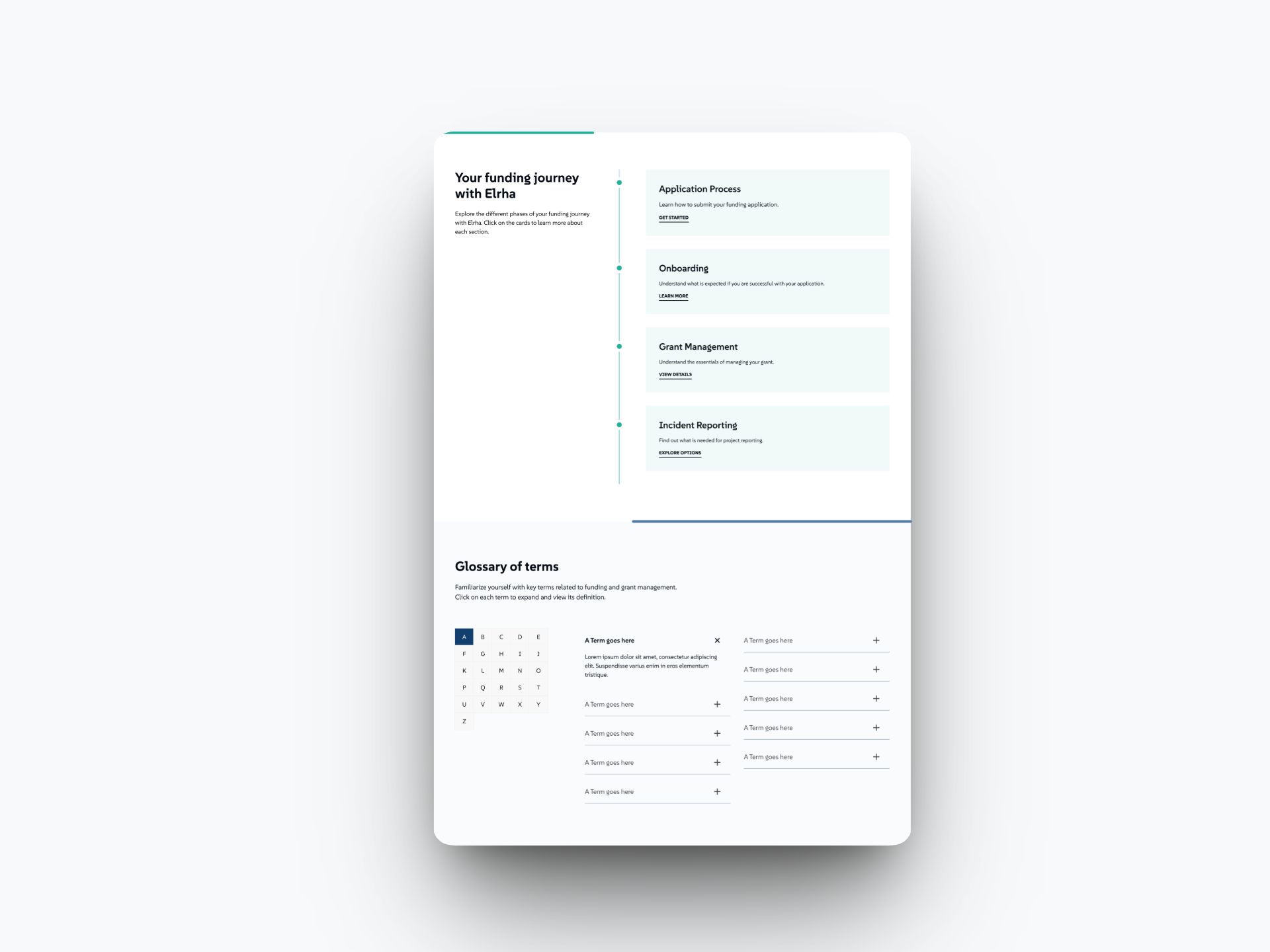
Our design process was rooted in the strengths of Elrha's existing brand. Rather than replacing it, we enhanced its expression – introducing complementary colours, a more dynamic visual rhythm, and a modern layout language that feels contemporary while remaining unmistakably Elrha.
Custom iconography was developed to reflect Elrha's key thematic focus areas, including Gender-Based Violence (GBV), Water, Sanitation and Hygiene (WASH), Mental Health and Psychosocial Support (MHPSS), and Nutrition. All layouts were designed to be clean, scannable, and accessible – with particular attention to legibility for users accessing content on mobile devices or in low-bandwidth environments.
3.5 – Webflow Development, Accessibility & SEO Implementation
The development phase took place across structured sprints, during which we built the full website in Webflow and executed the complete content migration. Key technical deliverables included:
- WCAG 2.0 AA compliance throughout, with AAA criteria applied where feasible
- Optimised page load performance for desktop and mobile, including users in humanitarian field contexts with limited connectivity
- SEO implementation: canonical tags, structured metadata, XML sitemaps, correct pagination logic, and schema markup
- Automated internal linking logic built into CMS templates, creating consistent cross-referencing between related content types
- Multilingual support for the Humanitarian Innovation Guide, with translations in Arabic, French, and Spanish
- Downloadable PDF version of the legacy guide, preserving access for users dependent on offline materials
A rigorous quality assurance process was conducted in two stages – first internally, then collaboratively with Elrha's team – before the site went live.
3.6 – Training, Documentation & Team Onboarding
As part of preparing the organisation for the new platform, we delivered a structured training and onboarding programme throughout the project. This included tutorial videos, written documentation, guidance notes, and hands-on sessions – ensuring that Elrha's staff felt confident managing content, publishing updates, and maintaining the site independently from day one.
The Impact
The redesigned Elrha website represents a substantial improvement across usability, accessibility, search visibility, and long-term organisational sustainability.
For Elrha's Global Audiences
- Significantly reduced time-on-task: users in testing found relevant content faster and with fewer navigation steps than on the legacy site
- Advanced filtering on resource hubs – including the MHPSS research library – enables practitioners and researchers to surface relevant content by topic, region, and publication type
- Improved accessibility for users in low-bandwidth environments, on mobile devices, and with assistive technologies
- A clearer understanding of Elrha's work, funding mechanisms, and how to access specific programmes or resources
For Elrha's Internal Team
- Webflow CMS enables staff to make content updates independently, without reliance on technical support
- Automated internal linking and standardised templates reduce admin workload while improving consistency
- Improved content governance tools ensure the site can grow in a structured and sustainable way
- A multilingual content framework supports Elrha's international reach and global programme portfolio
For Search Visibility
- Expanded keyword coverage beyond branded terms, targeting topic-level queries relevant to humanitarian innovation, research funding, and evidence-based programming
- Clean URL structures, correct canonicalisation, and structured metadata improve crawlability and indexation
- Fast page load speeds contribute to improved Core Web Vitals scores, a key Google ranking signal
Our Approach
Our work with Elrha was rooted in genuine collaboration and evidence-based decision-making. Rather than delivering a surface-level visual refresh, we engaged deeply with Elrha's audiences, internal team, and existing content landscape – ensuring the new website addressed real needs rather than assumed ones.
We brought together user research, UX design, content strategy, SEO expertise, accessibility best practices, advanced filtering and content discovery features, and full-stack Webflow development into a single, cohesive process. One of the defining strengths of the project was the balance we struck between honouring Elrha's established brand identity and giving it a refreshed, modern expression suited to the next chapter of the organisation's growth.
Another key contribution was our ability to guide Elrha through complex strategic decisions – including the CMS platform evaluation – by presenting clear, evidence-based comparisons rather than steering toward a predetermined outcome. The result is not simply a new website, but a long-term digital foundation: one that empowers Elrha's staff, serves a diverse global audience, and reflects the organisation's mission with greater clarity, reach, and impact.





Get in touch
If you’re interested in us building something similar for you too, then get in touch!
