Social Mobility Foundation Index
An annual assessment that evaluates how effectively UK employers support social mobility
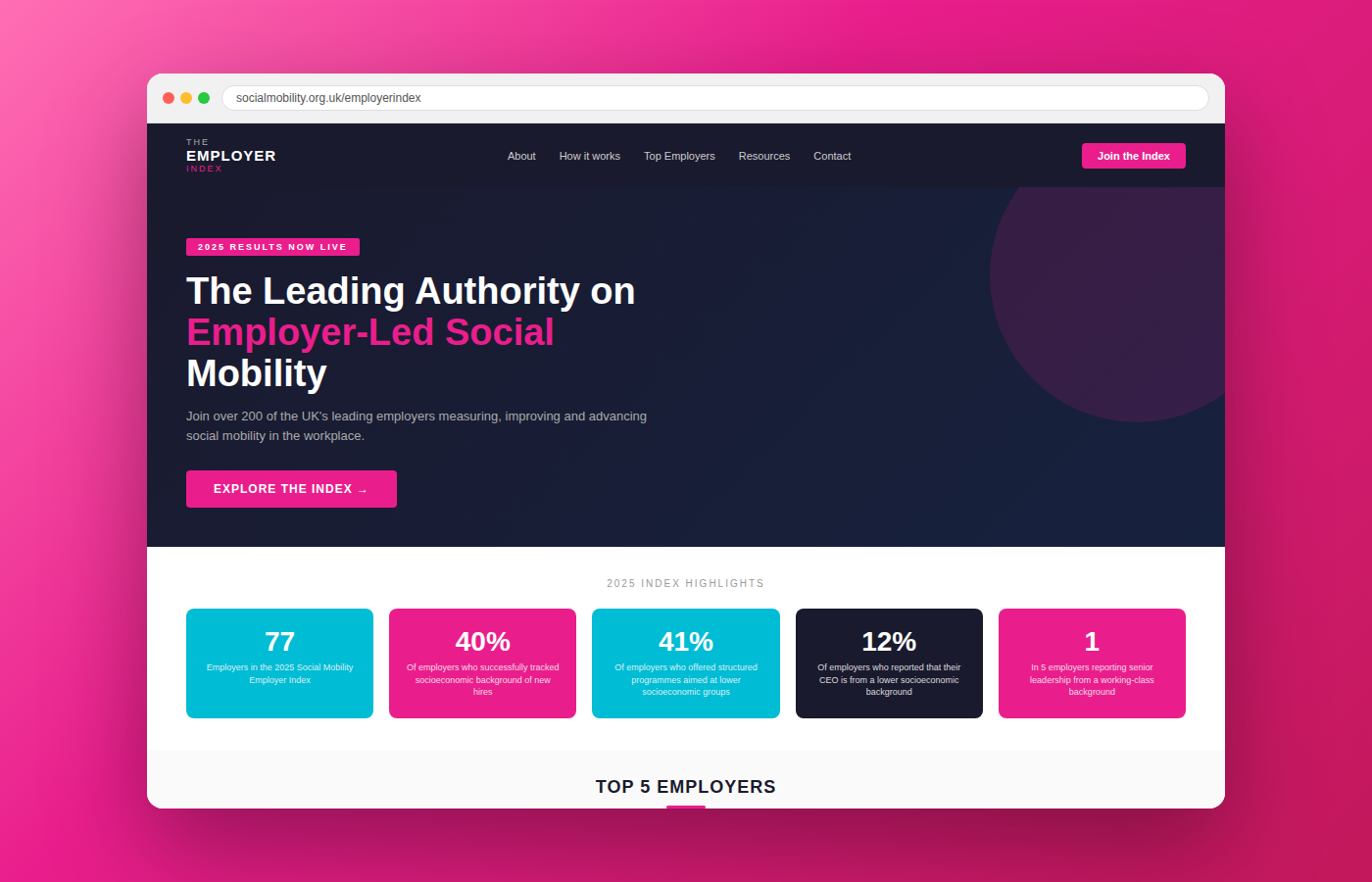

The Social Mobility Foundation’s Employer Index is a key annual programme, but its delivery relied heavily on manual processes, fragmented systems, and spreadsheet-based workflows. This created inefficiencies, increased the risk of errors, and limited the programme’s ability to scale as participation grew.
01 Where it all started
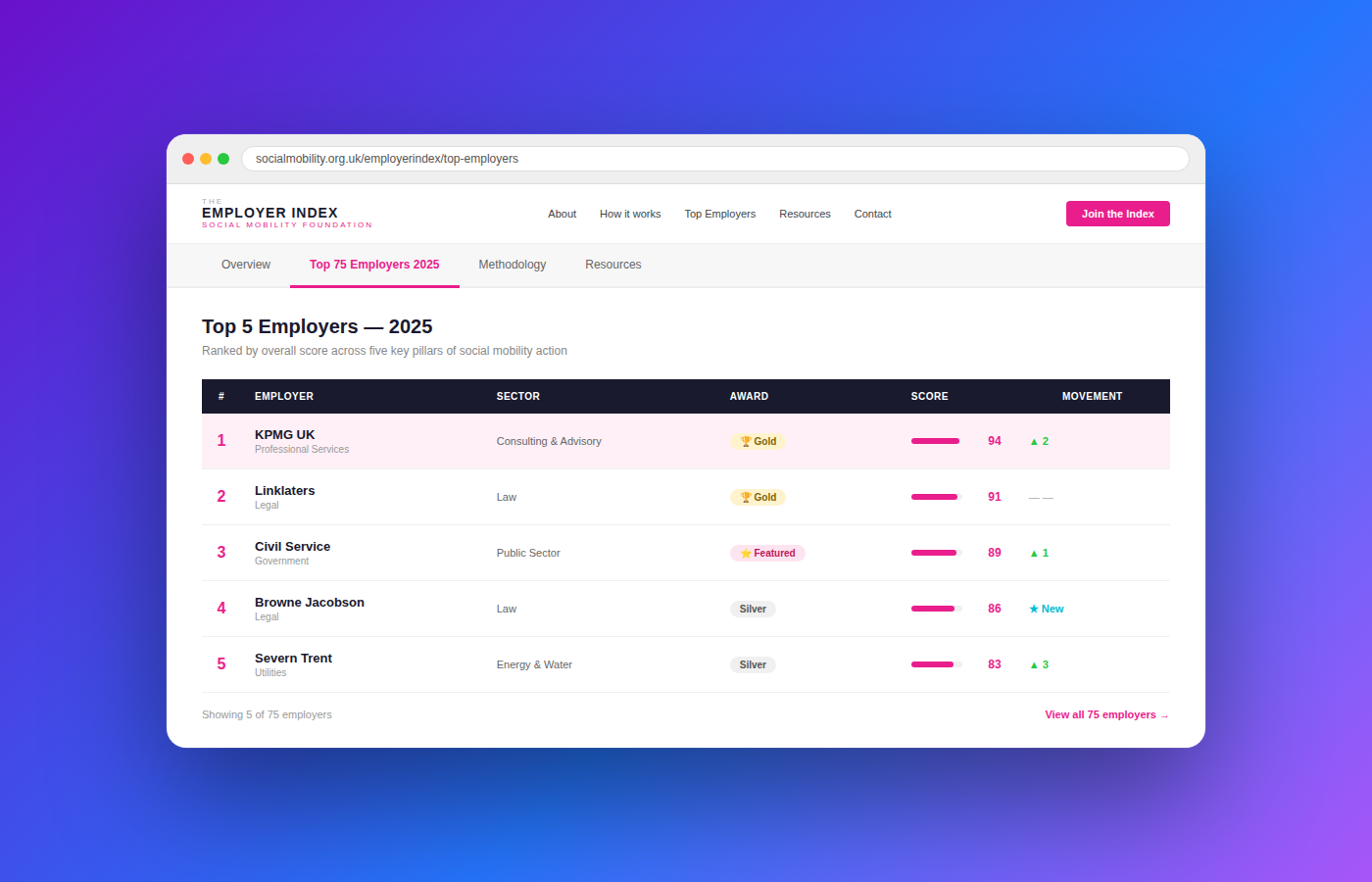
The Social Mobility Foundation (SMF) runs the Employer Index, an annual assessment that evaluates how effectively UK employers support social mobility. It is one of SMF’s flagship programmes and a key source of revenue. Each year, employers submit detailed information about their practices, receive a score and ranking, and are given a comprehensive feedback report that includes both quantitative results and tailored recommendations.
However, despite the importance of the programme, the underlying process was almost entirely manual. Submissions were stored in spreadsheets and shared by email; scoring required extensive manual calculation; and reports were compiled one by one in PowerPoint. With no single source of truth and multiple disconnected systems, the workflow was highly prone to errors, slow to manage, and relied heavily on staff capacity.
The impact on SMF was significant: peak periods created intense pressure on the team, inconsistencies became difficult to avoid, and the employer experience suffered as a result. More importantly, the programme could not scale; increasing participation risked overwhelming the staff responsible for running it. SMF needed a modern, robust, automated system that could streamline the entire workflow, improve accuracy, and create a more polished and reliable user experience.
02 Where we came in
We partnered with SMF to lead a full digital transformation of the Employer Index, rethinking the service from end to end and overseeing a major reconfiguration of their CRM to better suit their operational needs.
Our goals were to automate repetitive administrative work, reduce errors, and consolidate all data into a single, reliable system. Just as importantly, we wanted to give SMF the ability to manage their Index each year without technical support - including updating the survey, defining scoring logic, adjusting feedback, and generating reports.
To support this, we designed a new system anchored in their CRM Salesforce as the central data hub, paired with a dedicated React portal for employers. The architecture allowed for a seamless, consistent experience while giving SMF complete visibility and control. Throughout the project, we collaborated closely with SMF to ensure the transformed Index reflected their workflows, capacity, and long-term ambitions.
03 What we delivered
1.0 Co-Design, Research, and User Testing
The first stage of delivery focused on understanding how the Index truly worked - not just the documented process, but the knowledge held by staff. We ran co-design workshops to map the end-to-end flow, explore pain points, and identify where automation could genuinely add value.
Using this shared understanding, we prototyped the employer portal and key survey flows. User testing with a small group of employers and internal stakeholders helped validate navigation patterns, page layouts, and the clarity of the redesigned experience. These insights ensured that the new portal would feel intuitive and transparent for users completing long, detailed submissions. It has also created a strong foundation for further platform development, such as the ability for employers to access historical data and have more control over their reports.
2.0 Technical Architecture and System Design
We conducted a detailed review of SMF’s existing tools - Salesforce, spreadsheets, shared drives, payment systems and legacy documents - and designed a technical architecture that unified everything around Salesforce as the single source of truth.
A key component of this was the creation of a reusable, entirely configurable survey engine. Instead of rebuilding the Index each year, SMF can now create a new annual version directly inside Salesforce: updating questions, changing options, adjusting scoring, defining branching logic, and modifying automated feedback. The system handles all calculations, reducing both error risk and administrative load. At the same time though, the report generation is tailored so there is a clear workflow and capability for qualitative inputs as much as quantitive, maintaining space for nuance and human insight.
3.0 Design Thinking and Tech Training
A major priority of the project was ensuring the long-term sustainability of the Index. Throughout the build, we worked closely with the SMF team to clarify user journeys, document the logic behind scoring and feedback, and train staff in how to maintain the system themselves.
We delivered hands-on sessions covering editing surveys, updating logic, generating reports, reviewing results, and managing employer access, as well as delivered video tutorials and “how to” manuals. This continuous upskilling ensured that the team would be confident using the platform without depending on our development team.
4.0 Service Journey Mapping
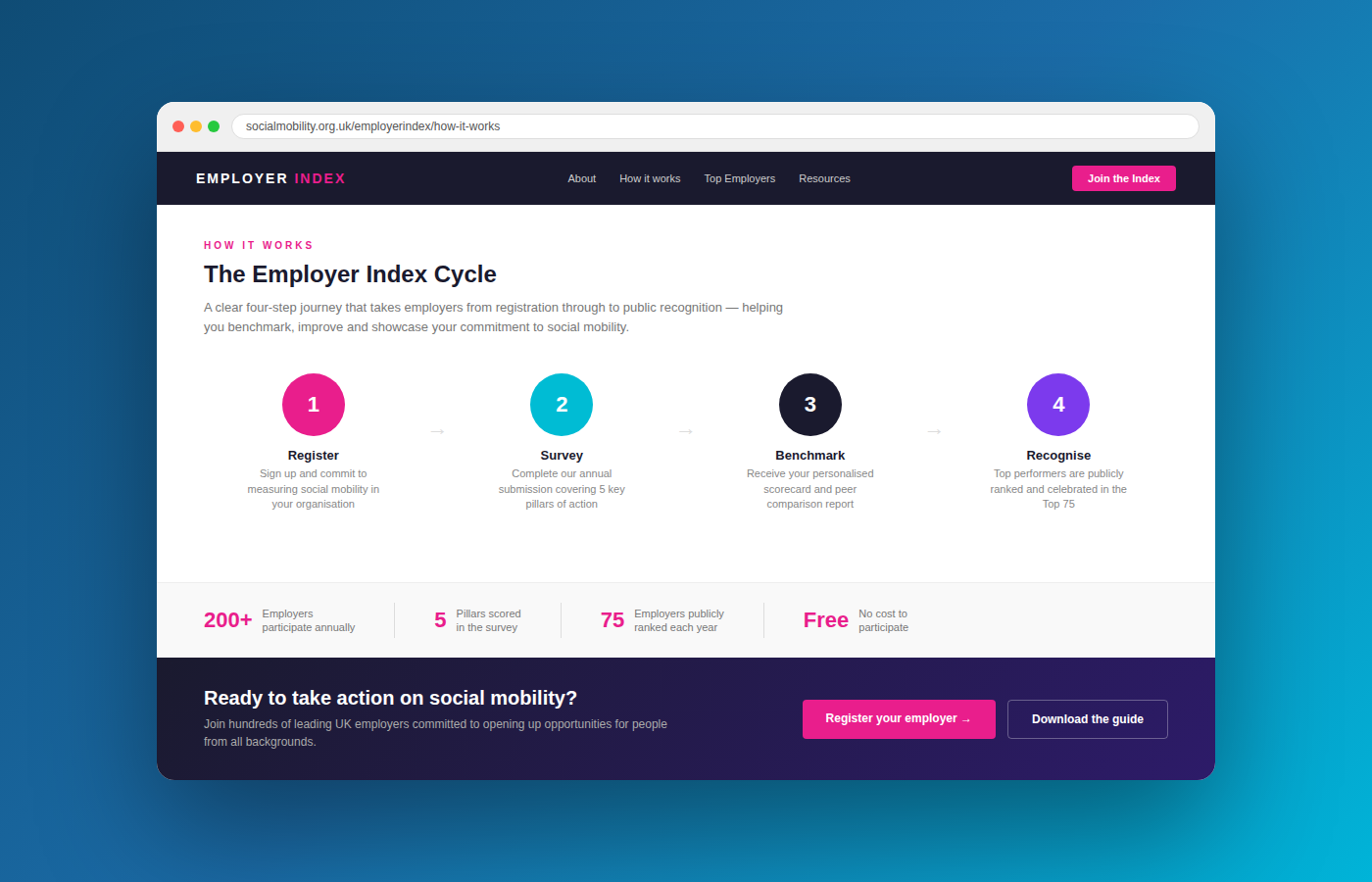
We mapped the full lifecycle of the Employer Index:
- Registration of interest
- Pre-survey communications
- Submission window
- Scoring and review
- Report generation and publication
- Payment
These journeys informed everything from the portal’s status views to automated notifications and internal review processes. As a result, employers now receive a significantly more transparent experience, with clear touchpoints that reflect the real rhythm of the programme.
5.0 Visual Language and Portal Experience
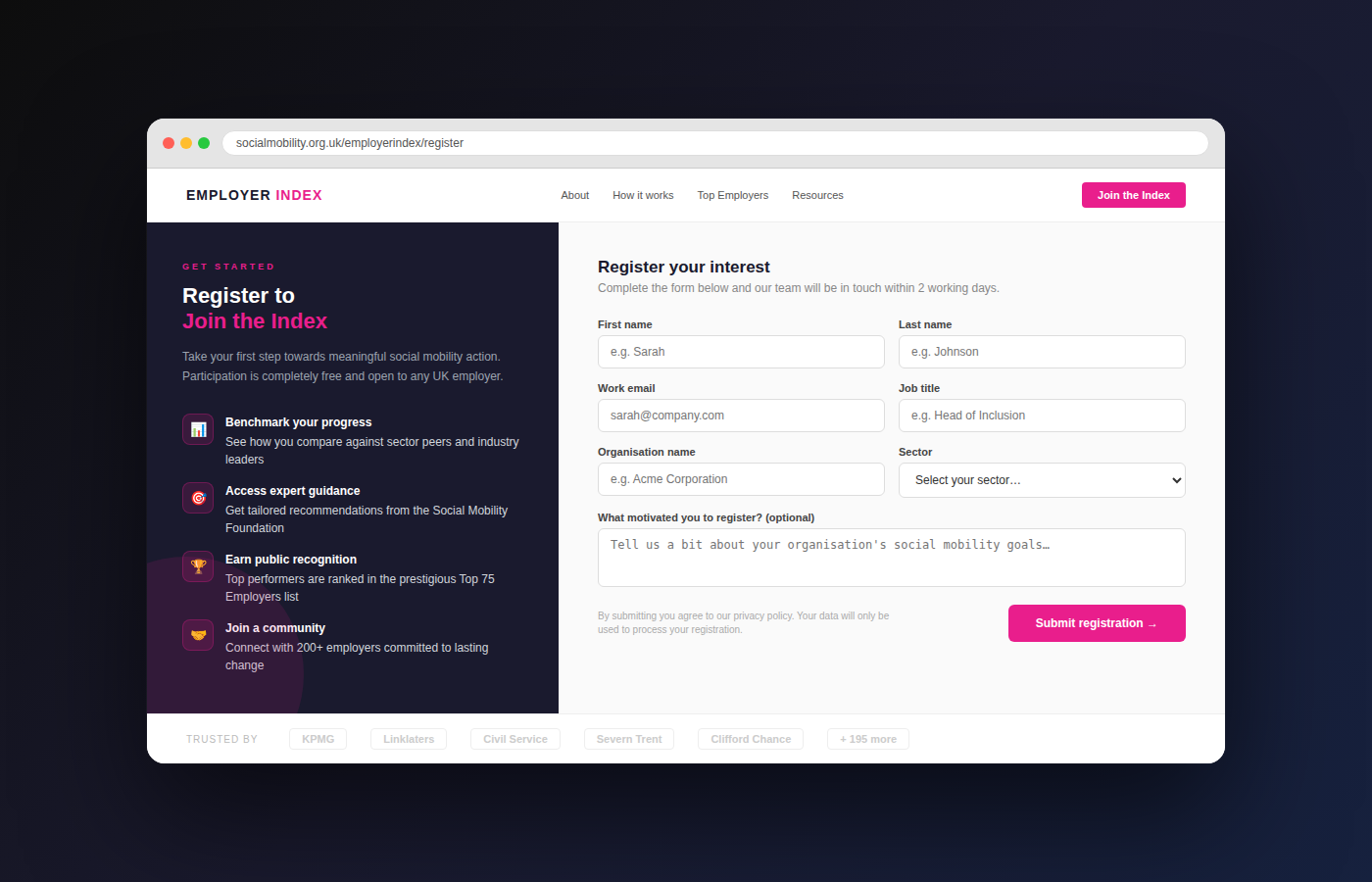
The employer portal was designed to offer simplicity and clarity, particularly given the volume of information employers must provide. We created streamlined flows for registration and login, a submission dashboard that shows progress and upcoming milestones, and a resource hub that centralises guidance materials.
Visual choices were guided by accessibility, focus, and reducing cognitive load. The goal was a tool that looks clean and modern while staying out of the way - supporting employers in completing a complex assessment with confidence. In doing this we have now provided a central place for the employers to also access and manage current and historical data.
6.0 Development Sprints and Testing
The platform was built iteratively, with development sprints followed by rounds of internal and client testing. The Salesforce backend and React frontend were tested extensively to ensure accurate scoring, correct application of automated feedback, and clean assembly of the final report.
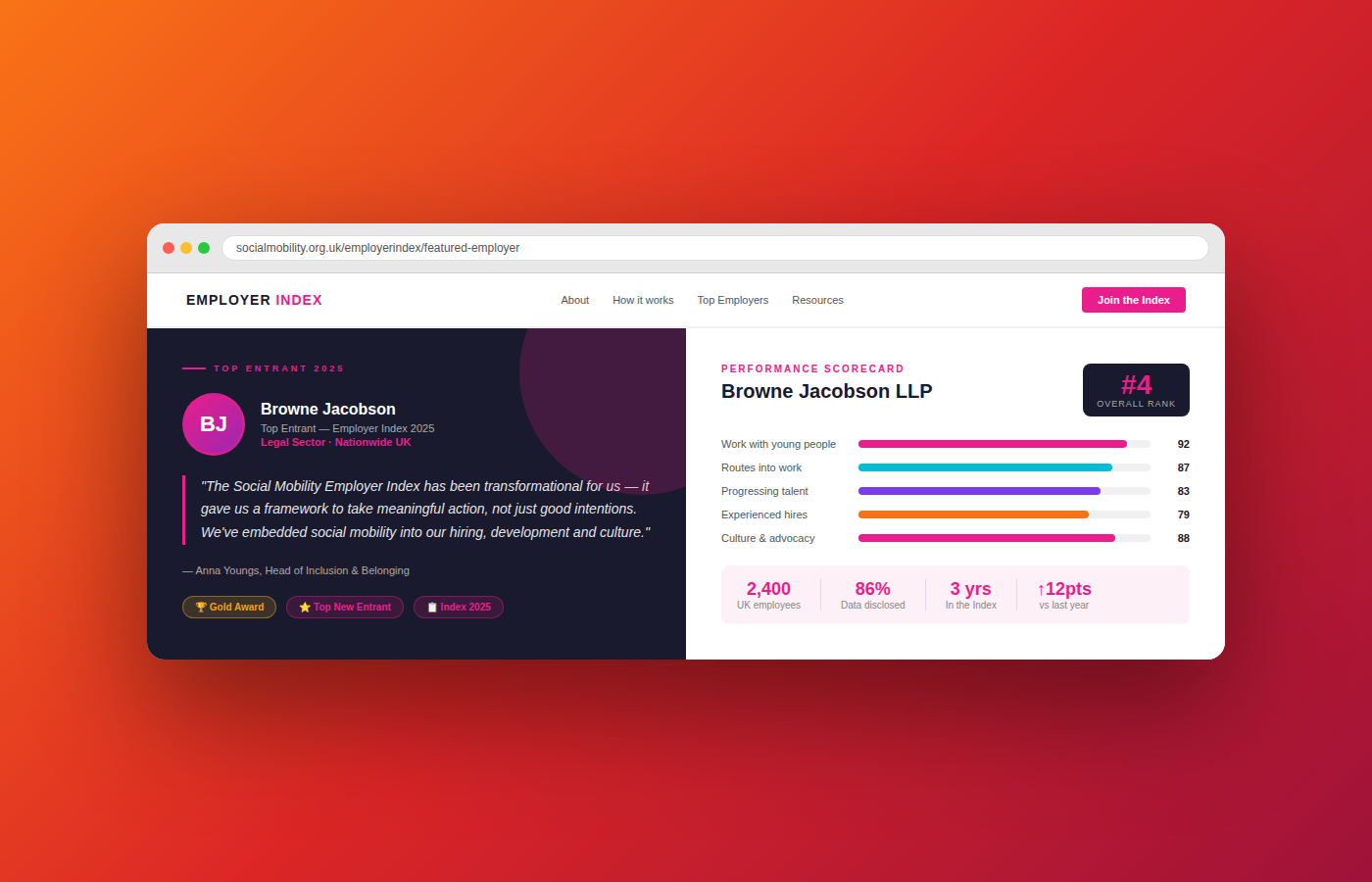
We tested branching logic across the survey, validated calculations, and ensured the report would reliably pull in narrative feedback, visuals, and RAG (red–amber–green) scoring thresholds. The result is a stable and resilient experience that handles a large amount of data without compromising accuracy.
7.0 Salesforce Integration and Automated Report Generation
The final solution is a fully integrated ecosystem. Salesforce now manages every step of the Index lifecycle:
- annual survey configuration
- scoring and automated feedback
- customisable narrative inputs
- visualisation rules and colour-coding logic
- data storage and versioning
- full report assembly and review
The employer portal, built in React, connects directly to Salesforce to provide real-time access to submission progress, timelines, resources, and the final report on publication day.
The system is designed for autonomy: SMF can now run each year's Index with full control and without developer intervention.
04 Impact
The transformation has had an immediate and far-reaching impact on both SMF’s internal operations and the employer experience.
For the SMF team, the new system eliminates much of the repetitive and error-prone manual work that previously consumed long hours during peak Index periods. Scoring, feedback application, and report generation are now largely automated, allowing staff to focus on analysis, quality assurance, and employer engagement. The presence of a single data source also provides a level of clarity and reliability that was previously impossible, improving confidence in the final published results.
Employers now interact with a clear, centralised portal where timelines, progress, and resources are easy to understand. The submission process feels more structured, and reports are delivered more consistently. These improvements strengthen the overall experience and support SMF’s goal of increasing participation in future cycles.
Overall, the transformation positions the Employer Index to grow sustainably, support more employers, and uphold its role as a respected national benchmark for social mobility performance.
05 Our unique value
What made our contribution distinctive was the combination of service design, technical strategy, and Salesforce engineering, all working together to modernise a complex, high-stakes programme.
Rather than treating this as a software build, we approached it as a full service transformation. We redesigned workflows, clarified journeys, and ensured the digital tools reflected how the programme truly operates. We created an architecture that balances automation with human judgement - allowing the system to handle calculations and assembly, while giving staff the ability to personalise and refine employer reports.
Above all, the solution empowers SMF’s team. They can now manage the Index independently, create new annual surveys, adjust scoring logic, update feedback, and generate polished reports without technical support. This autonomy is what makes the system not only functional, but future-proof, ready to evolve with SMF’s ambitions, support sector-level reporting, enable multi-user submissions, and integrate payments in future phases.





Get in touch
If you’re interested in us building something similar for you too, then get in touch!
